The Applied Intelligence Blog
Applied Intelligence Definition: How It Differs From Applied AI
An Applied Intelligence definition in plain English, how it differs from applied AI, and a worked example from a U.S. HVAC contractor.
Here is the Applied Intelligence definition we work by: Applied Intelligence is AI put to work inside a system, with a team behind it, until it pays off every day. If you lead a business, run a crew or plan your next career move, that difference matters more than any model release. It decides whether AI becomes part of how you work or stays a tab you opened once.
People often use "applied AI" and "Applied Intelligence" as if they meant the same thing. They don't, and the gap between them is where most American businesses and workers are stuck today. This post sets the two side by side, walks through one worked example from a heating and cooling contractor, and ends with a short test you can run on any AI project this week.
The definition, part by part
At Norventus we write it as a simple sum:
Applied Intelligence = AI + Team + System design + Curation + Customer success.
Each part has its own job.
- AI. The models and tools. Necessary, and the smallest part of the work.
- Team. People who apply it with you, online and on site, and who learn how your work actually runs.
- System design. The work is redesigned around AI, with its data, people and follow-up. It is not the old process with a chatbot bolted on.
- Curation. Choosing the few tools that fit your work and dropping the rest.
- Customer success. Staying until the tools are used every week, and improving them after that.
We cover the meaning of each part in more depth in what Applied Intelligence is. Here the point is narrower: what changes when you add the four parts that are not AI.
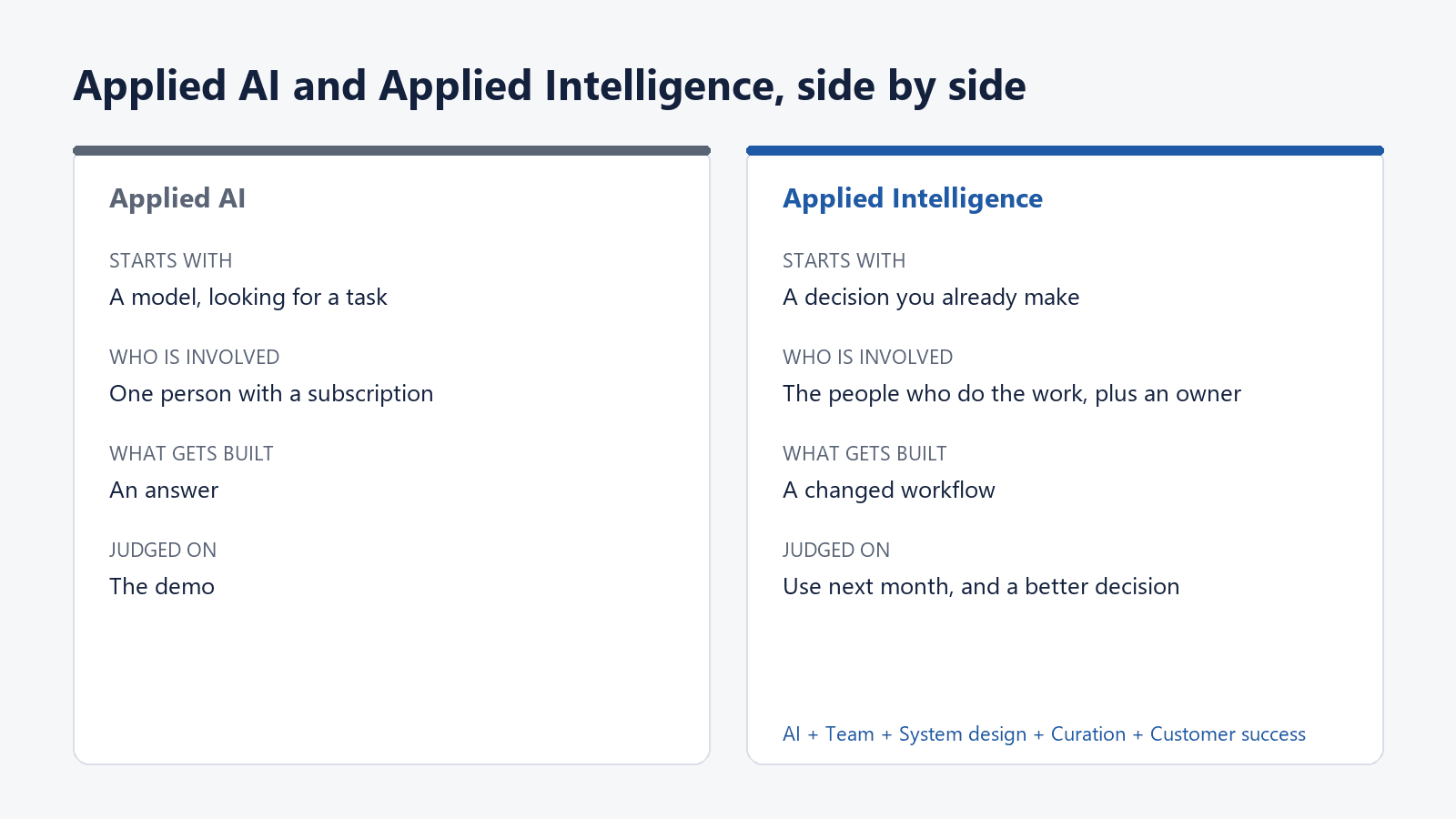
Applied AI and Applied Intelligence, side by side
Applied AI usually means taking a model and pointing it at a task: summarize these notes, draft this email, classify these tickets. That is useful work, and it is the first step. But it stops at the tool. Nobody owns what happens next.
Applied Intelligence starts one step earlier and ends much later. It starts with your goal, decision or task, the Intent barrier, and asks whether AI should be involved at all. It ends only when the work is part of a normal week, the Consistency barrier.
Here is the difference in four plain lines.
- Where it starts. Applied AI starts with a model and looks for a task. Applied Intelligence starts with a decision you already make and asks what would make it better.
- Who is involved. Applied AI is often one enthusiast with a subscription. Applied Intelligence involves the people who do the work, someone who sets it up, and someone accountable for keeping it useful.
- What gets built. Applied AI produces an answer. Applied Intelligence produces a changed workflow: what comes in, who reviews it, where the output goes and when it is used.
- How success is judged. Applied AI is judged on the demo. Applied Intelligence is judged on whether people still use it next month, and whether the decision got better.
Neither one is wrong. Applied AI is a part of Applied Intelligence, the same way an engine is part of a truck. You can admire an engine on a stand, but it does not haul anything until someone builds the rest of the truck around it and keeps it serviced.
A worked example: the service call backlog
This is an illustration, not a customer story. Picture a 40-person heating and cooling contractor in the Midwest. Every summer heat wave and every winter cold snap, the phones flood. Dispatchers juggle callbacks, technicians arrive without the part they need, and the owner spends evenings rebuilding the next day's schedule by hand.
The applied AI version. The office manager signs up for an AI assistant and uses it to summarize voicemails into short notes. It saves her some time for two weeks. Then the notes pile up in a folder, because nobody decided what happens to them, and the dispatch board still runs the old way. When the next cold snap hits, everyone goes back to the phone and the whiteboard.
The Applied Intelligence version. The work starts from the owner's real decision: which calls go first tomorrow, and which technician takes each one. Then the four other parts come in.
- Team. Someone sits with the dispatchers and two senior technicians for a day and learns how a call actually turns into a visit, including the shortcuts nobody writes down.
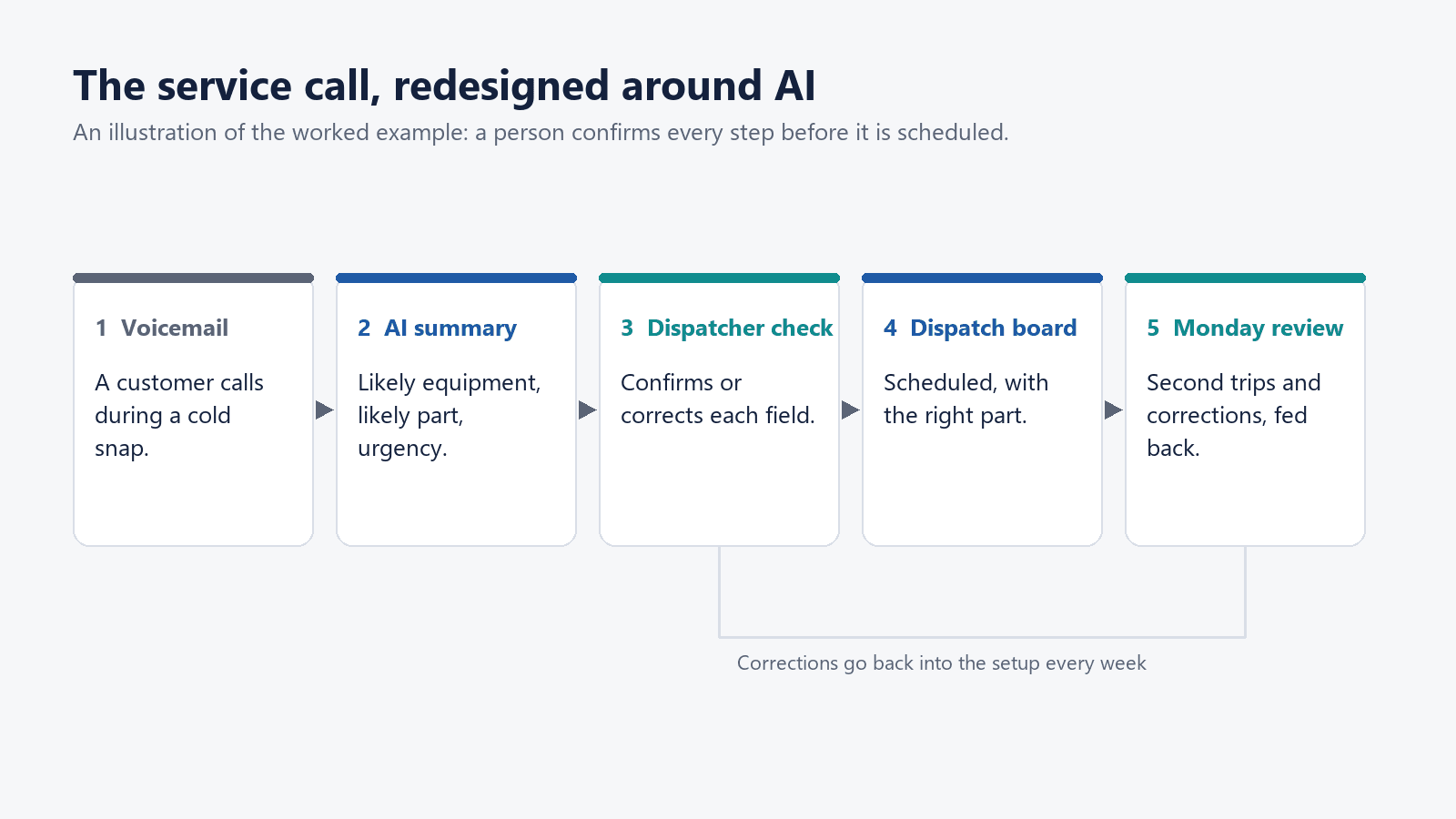
- System design. Each voicemail summary now lands on the dispatch board with three fields filled in: the likely equipment, the likely part, and how urgent it sounds. A dispatcher confirms or corrects each one before it is scheduled, so a person stays responsible for every call.
- Curation. The contractor keeps one assistant and one board. The two other apps someone had tried get switched off, so nobody wonders where to look.
- Customer success. Every Monday the owner sees how many calls were scheduled from the board, how many first visits needed a second trip, and which summaries the dispatchers corrected. The corrections go back into the setup. A month later, someone checks in.
The AI in both versions is the same. What changed is everything around it. In the second version the contractor can see whether technicians arrive with the right part more often, because the system records it. In the first version there is nothing to look at, so nobody can tell whether the subscription helped.
Why the definition matters in the United States now
Access to AI is not the hard part anymore. Anyone in America can open an AI app on a phone in a minute. What most people lack is clarity: why they would use it, what for, and how to make it stick. That is the gap Applied Intelligence is built to close.
The opportunity is largest in the places that have been left out so far: manufacturing, construction, logistics, field services, the trades, and the small and mid-sized businesses that keep local economies running. These businesses rarely have a data team or a spare afternoon. They need someone to bring the definition down to one decision, one crew and one Monday meeting. Our guide to AI for small business owners shows where that first decision usually pays off.
The same holds for individual careers. An electrician, an analyst or a project manager who learns to apply AI to their own work, with a plan and a weekly habit, is building an advantage that a one-off experiment never gives. Ambition is the starting point. A system is what turns it into results.
How Norventus applies it
Norventus is built around one idea: Applied Intelligence for Everyone. We carry the definition through three products, each for a different starting point.
- Watch Tower is Applied Intelligence for your Business: one Console where leaders see the business, its evidence and its decisions, built with the people who know the work.
- Forge is Toolkits for your Work: small, clear tools for everyday jobs in the field and at the desk, with the assumptions behind every number shown.
- Beacon is Applied Intelligence for your Career: a career console and an ambition planner that works back from where you want to be.
Each product is designed to cross the five barriers in order, which we explain in the five barriers to using AI.
A five-question test for any AI project
You can use the definition as a test whether or not you ever work with us. Before you start, or restart, an AI project, answer five questions:
- Which decision or task is this for, and how often does it come up?
- Who will help us apply it, and who owns it once it is running?
- How does the work change around it, step by step?
- Which tools are we dropping so this one fits?
- Who checks in a month from now, and what will they look at?
If you can answer all five, you are doing Applied Intelligence. If one answer is blank, that is the barrier to work on next.
Your next step
Pick one decision you make every week and write down the five answers above. Then read how we approach it on the Applied Intelligence page, or browse our three products to find the one built for where you are starting.
Frequently asked questions
Is applied AI the same as Applied Intelligence?
No. Applied AI points a model at a task, such as summarizing notes or drafting an email, and usually stops at the tool. Applied Intelligence starts from a decision you already make and ends only when the changed workflow is part of a normal week, with a team, system design, curation and follow-up around the AI.
What are the five parts of the Applied Intelligence definition?
The Applied Intelligence definition has five parts: AI, Team, System design, Curation and Customer success. AI is the models and tools. The team applies them with you, system design reshapes the work around them, curation keeps only the few tools that fit, and customer success stays until they are used every week.
What is an example of Applied Intelligence in a small business?
A heating and cooling contractor that turns voicemails into dispatch-board entries is one example of Applied Intelligence. Each summary lists the likely equipment, part and urgency, a dispatcher confirms it, unused apps are switched off, and the owner reviews corrections and second trips every Monday. The AI is the same; the system around it changed.


.jpg)